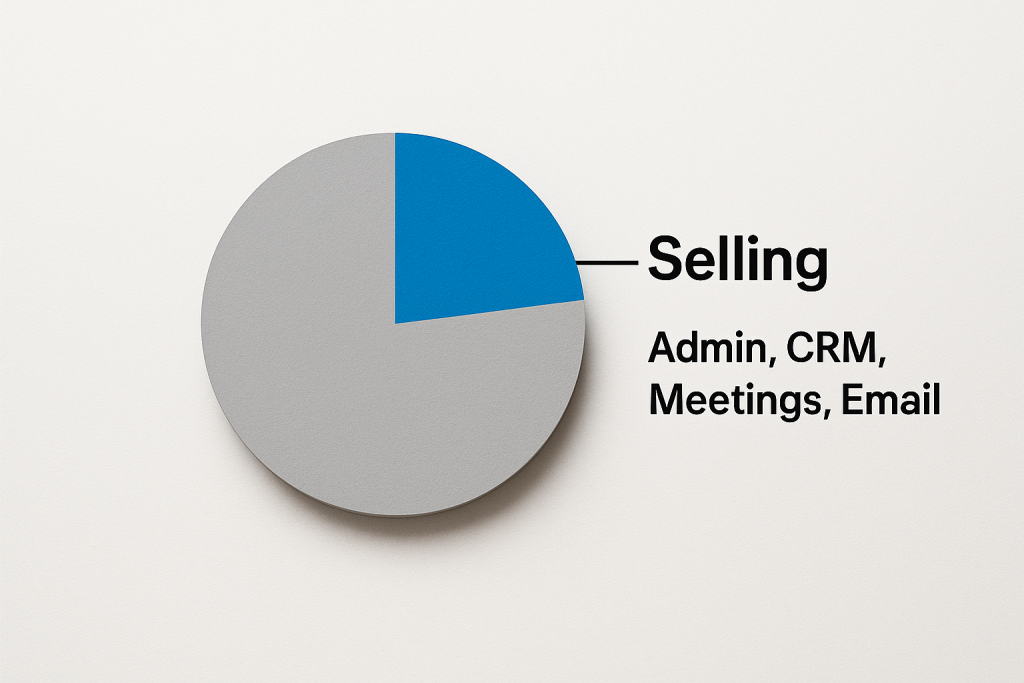
B2B sales reps sell for only 28% of their week. The other 72% is lost to admin, meetings, CRM updates, and email triage. That gap costs teams millions in missed quota each year. This guide shows where the time goes, what it costs, and how top performers claw it back.
One stat sums up the crisis. Salesforce’s State of Sales reports that reps spend 70% of their time on non-selling tasks, per Everstage’s 2026 roundup. Forrester puts active selling even lower — just 23% of the work week, based on Forrester’s productivity research. The lack of focus on B2B sales reps is not a soft problem. It is a revenue leak.
Why Lack of Focus on B2B Sales Reps Is the #1 Hidden Cost
Most sales leaders blame missed quota on weak leads or lazy reps. The data says otherwise. Reps want to sell. They just can’t get to the phone.
If you still measure your team by hours logged or CRM fields filled, here is what it costs you. Your top closer spends 5 of every 8 hours on tasks that bring in zero revenue. Multiply that across 10 reps and 50 weeks. You are paying for thousands of hours of busywork.
Only 25% of B2B sales reps hit quota in 2024, according to SPOTIO’s 2026 statistics roundup. That is not a talent problem. That is a focus problem.
What does “focus” really mean in sales?
Focus in sales means time spent in direct buyer contact — calls, demos, emails to live deals, and follow-ups. Everything else is overhead. When reps protect this time, win rates rise. When they don’t, deals slip.
Takeaway: The 72% gap is the biggest lever you have. Fix focus before you hire more reps.
Where the Week Actually Goes: A Breakdown of Wasted Time
Now that we know the gap is real, the next question is simple: where does the time go? You can’t fix what you can’t see. Salesmotion’s audit of rep workweeks breaks the 40-hour week down by activity. The numbers are brutal.
| Activity | % of Week | Hours | Revenue Impact |
|---|---|---|---|
| Active selling (calls, demos) | 28% | 11.2 | Direct |
| CRM data entry | 17% | 6.8 | None |
| Internal meetings | 15% | 6.0 | Minimal |
| Account research and prep | 14% | 5.6 | Indirect |
| Email triage and admin | 14% | 5.6 | None |
Look at the numbers again. 6.8 hours a week per rep on CRM updates alone. That is almost a full workday spent typing notes instead of speaking with buyers. Momentum’s research found reps spending close to 30% of the week just cleaning CRM and writing follow-up notes.
Takeaway: CRM admin is the single biggest non-selling cost — fix it first.
The Common Distractions Killing Sales Productivity
CRM is the biggest leak, but it is not the only one. The 72% is not one big problem. It is a mix of small leaks. Here are the worst ones, ranked by how much time they steal.
- Manual CRM updates. Notes, stage changes, contact fields — all done by hand after every call.
- Tool overload. Mixmax warns that many teams juggle 20+ apps. Switching between them drains hours each day.
- Internal meetings. Forecast calls, pipeline reviews, training, syncs. Six hours a week, per Salesmotion.
- Bad data and dead leads. Qualfon found reps still working old records and calling during dead time windows.
- Approval bottlenecks. Gartner data shared on LinkedIn shows 20% of stalled deals die because of complex internal policies.
- Irrelevant outreach loops. Salesforce reports 73% of B2B buyers avoid sellers who send generic messages — wasting both sides’ time.
Why is tool overload such a big deal?
Each app switch breaks focus. Reps lose context, miss data, and waste minutes finding the right tab. The cure is fewer, deeper tools — not more.
Braxton Carr at UserGems puts it plainly: reps should live in a handful of core tools — CRM, Gong, Calendar, Zoom — and almost nothing else.
Takeaway: Cut your sales stack in half before adding one more app.
The Real Financial Cost of Distraction
Listing the leaks is one thing. Pricing them is another. Now let’s put a dollar number on it. Take a 10-rep team at $120k OTE each. That is $1.2M in payroll. If only 28% of their time is selling, you are paying $864,000 a year for non-selling work.
The damage does not stop at payroll. Deals stretch. Quotas slip. EBQ reports that more than 50% of companies saw longer sales cycles in 2023. Every extra week is more rep time per deal — and less new pipeline.
Chief Outsiders ties the same imbalance to burnout. Overwhelmed reps quit. Replacing one B2B seller costs 6 to 12 months of ramp time. So lost focus also drives lost talent.
How much revenue does lost focus actually cost?
If you give each rep back just 5 hours of selling per week, you double their buyer contact time. Top teams see win rates climb when active selling crosses 34% of the week. That number comes from Forrester data cited by Everstage — organizations above 90% quota attainment hit that 34% mark.
Takeaway: Every 1% of selling time recovered is direct pipeline you already paid for.
Multitasking: The Silent Productivity Killer
So far we have counted hours and dollars. But there is one hidden cost the spreadsheet misses: the brain tax of switching tasks. Many reps think they multitask well. The science says no one does.
Prialto cites the American Psychological Association: jumping between tasks cuts productivity by as much as 40%. Worse, it takes an average of 26 minutes to fully refocus after a switch.
So a rep who checks Slack between every call loses nearly half a day to context switching. Not to Slack itself — to the recovery time after Slack.
Top performers know this. Sales Insights Lab found that 81.6% of top performers spend 4+ hours a day on sales activities, versus 60.8% of non-top performers. The gap is not talent. It is protected blocks of deep work.
Takeaway: Batch tasks. One hour for calls, one for email, one for CRM. No mixing.
How Top Performers Win Back Focus: The Playbook
If multitasking is the disease, structure is the cure. The winners do not just “try harder.” They build systems that protect selling time. Here is what shows up again and again in the data.
1. Time-block the calendar like a CEO
Reps who block 2-3 hour selling windows hit quota more often. Close’s time management guide calls automation “key to recovering wasted time” — but only if you guard the recovered hours.
2. Batch every non-selling task
Do all CRM updates at 4pm. Triage email twice a day. Take internal meetings on Mondays and Fridays only. The American Psychological Association’s 26-minute refocus rule means batching gives you back hours per week.
3. Kill dead-time calling
Qualfon’s audit showed certain hours produced zero connect rates — yet reps kept dialing. Map your team’s connect rates by hour. Move outreach to the windows that actually work.
4. Trim the lead list, raise the bar
An abundance of dead records keeps reps busy without producing deals. Cut the list in half. Reps work fewer, better accounts.
5. Address objections early
Per Gong data cited by Markham Board of Trade, top reps address objections 36% more than peers. Handling objections upfront stops deals from stalling later — which saves dozens of hours of chasing.
Real selling skill matters too. Our earlier piece on emotional intelligence in sales shows how the best closers read the room — something no automation can replace.
Takeaway: Top reps don’t work harder. They protect fewer hours and use them better.
Using Technology and AI to Cut Time Waste
Habits alone won’t close the 72% gap. The other half of the fix is tooling. Manual work is the enemy of focus. Smart automation is the fix. IBM’s productivity guide points to the same three areas every time: data entry, reporting, and meeting scheduling.
Here is where AI moves the needle most for B2B reps today:
- Automatic CRM updates. AI listens to calls and fills in notes, stage changes, and next steps. Recovers ~6 hours a week per rep.
- AI follow-up drafting. Personalized emails written in seconds, not 20 minutes.
- Lead scoring and routing. Reps work only the accounts most likely to close.
- Approval workflows. Per the Gartner data shared on LinkedIn, AI routing can save the 20% of deals lost to internal red tape.
- Meeting scheduling bots. No more email ping-pong over a 15-minute slot.
SPOTIO’s outside sales guide sums it up well: use AI to enhance human judgment, not replace it. The rep still picks the talking point. AI just hands them three good options.
That is the exact thinking behind why we built our platform — see our launch announcement for the full story.
What is the fastest automation win?
Auto-logging calls into the CRM. It removes the single biggest time waste — 6.8 hours a week — without any rep behavior change.
Takeaway: Automate the boring stuff first. Reps will thank you and quota will follow.
What Sales Managers Should Do This Quarter
Tools and habits stick only when leaders enforce them. Managers set the rules of the game. If you want focus, you have to design for it. Here is a 90-day plan based on the patterns from The Sales Blog and the data above.
- Audit the week. Have every rep track time for 5 days. Compare to the Salesmotion baseline.
- Cut one meeting. Pick the lowest-value internal sync and kill it. Recover 1 hour per rep per week.
- Set protected selling blocks. No internal pings during 9-11am and 2-4pm.
- Buy one tool, kill three. Replace overlapping apps with one platform reps actually use.
- Track the right metric. Stop counting calls. Start counting hours in active selling.
- Coach on focus, not just pipeline. Ask each rep weekly: “What broke your focus this week?”
Forecastio warns that when targets feel out of reach, reps disengage. Tight focus systems make quota feel possible again — which restores motivation.
Takeaway: Managers who measure focus, not activity, build quota-crushing teams.
The Path Forward: Sell More by Doing Less
The lack of focus on B2B sales reps is the most expensive problem in modern sales. It is bigger than bad leads. It is bigger than weak scripts. It is the silent reason 75% of reps miss quota, per SPOTIO.
The fix is not more hustle. It is fewer tools, tighter blocks, smarter automation, and a manager who protects selling time like gold. The teams that do this push selling time from 28% toward that 34% Forrester benchmark — and watch quota attainment follow.
Your Next 7 Days: A Sales Manager Action Plan
Don’t close this tab and forget it. Pick the steps below and run them this week.
- Today: Email your team the Salesmotion breakdown. Ask each rep to guess their own active selling %.
- Day 2: Open every rep’s calendar. Block 9-11am and 2-4pm as “selling only” for the next 30 days.
- Day 3: List every tool your team pays for. Cancel the bottom three by usage.
- Day 4: Pick one recurring meeting to kill. Tell the team why.
- Day 5: Turn on auto call-logging in your CRM (or pilot an AI note-taker on 2 reps).
- Day 6: Run a 15-minute team huddle on the 26-minute refocus rule. Agree on Slack quiet hours.
- Day 7: Measure. Compare this week’s active selling hours to last week’s. Share the win.
Want help running this playbook with AI doing the heavy lifting? See how 7Hats.ai automates CRM updates, follow-ups, and scheduling — so your reps spend their hours selling, not typing. Book a demo, audit one rep’s week, or just kill one meeting today. That is how the 72% gap closes.
Frequently Asked Questions
How much time do B2B sales reps actually spend selling?
Between 23% and 30% of the work week, depending on the study. Salesforce reports 30%, Salesmotion 28%, and Forrester 23%. The rest goes to admin, meetings, CRM, and email.
What is the biggest time-waster for sales reps?
Manual CRM data entry. Reps lose about 6.8 hours a week — nearly a full workday — typing notes and updating records that automation can handle.
How does multitasking hurt sales performance?
The American Psychological Association found multitasking cuts productivity by up to 40%. It also takes 26 minutes on average to fully refocus after a task switch.
How much does poor focus cost a sales team financially?
For a 10-rep team at $120k OTE, paying for 72% non-selling time costs roughly $864,000 in payroll a year. Add longer sales cycles and missed quotas, and the real cost is far higher.
What is the fastest way to give reps more selling time?
Automate CRM logging and follow-up drafting. These two tasks alone steal 10+ hours per rep per week and require zero behavior change to fix.
Why do most B2B sales reps miss quota?
Only 25% of B2B reps hit quota in 2024, per SPOTIO. The main driver is not skill — it is lack of selling time. When active selling drops below 28% of the week, win rates fall with it.