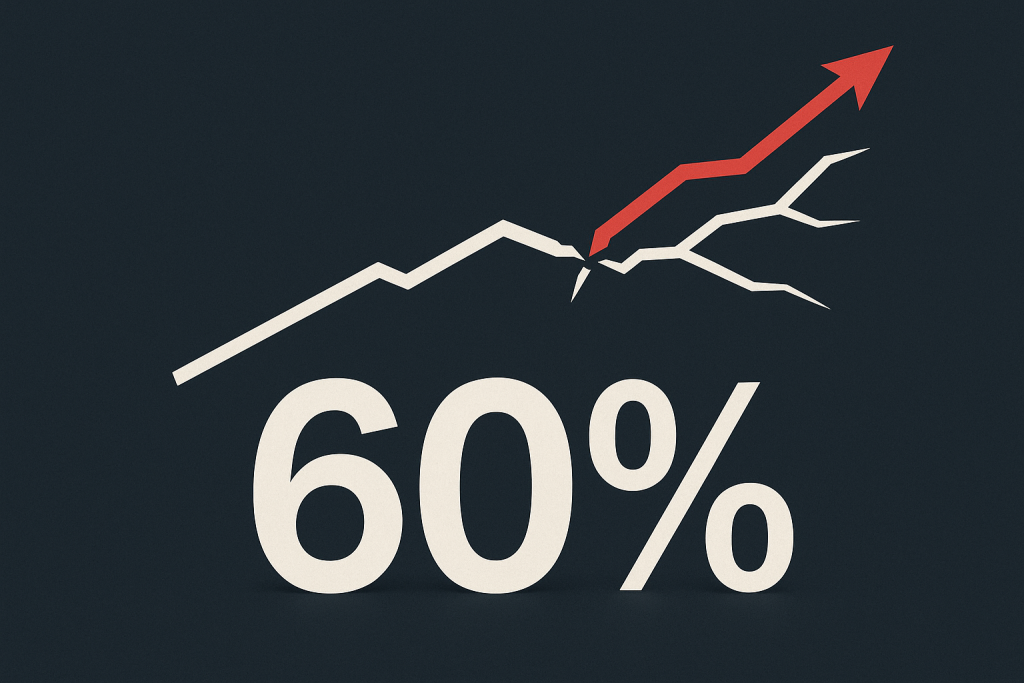
The year is 2026. The recession is 14 months old. Six out of ten B2B sales teams will miss their full-year quota. Their pipelines did not shrink overnight. They cracked slowly, deal by deal, while leaders kept running the same 2023 playbook. A dynamic B2B sales strategy is no longer a nice idea. It is the only thing that keeps revenue alive when buyers freeze.
This article is a pre-mortem. We look back from a future that has not happened yet, so you can fix what is breaking today. The 60% miss-rate claim is editorial. It mirrors the warning signs in Forrester’s downturn guide and the recession ripple model from NetSuite, which both show why static teams fall hardest.
The Pre-Mortem: What Killed B2B Pipelines in 2026
Picture the Monday morning sales meeting in January 2026. Win rates are down. Deal cycles have doubled. Three reps just quit. The VP of Sales opens the deck and shows the same forecast model used in 2022.
That is the moment the company lost the year.
According to NetSuite, a recession ripples through the whole economy. When buyers spend less, B2B spending drops too. Unemployment rises. Then demand falls again. It is a loop. Teams that do not change their plan get pulled down with it.
The teams that survived 2026 did one thing right. They threw out the static plan and built a dynamic B2B sales strategy that could shift every 30 days.
Takeaway: Static plans built in good times always break in bad times. Action: block 2 hours this week to pressure-test your current plan against a 20% pipeline drop.
The Problem: Most Teams Are Still Selling Like It Is 2021
If you still run the same outbound motion, the same pricing, and the same forecast cycle you used two years ago, here is what it costs you right now.
Buyers have changed. They form bigger buying committees. They ask for more proof. They cut budgets in the middle of a deal. Yet most reps still send the same email, pitch the same demo, and chase the same ideal customer profile.
Forrester tells sales leaders to first study the real impact of inflation and tight supply on their buyers. Most teams skip this step. They guess. Guessing is expensive.
What does a static sales strategy actually cost you?
It costs you cash, time, and your best reps. Win rates drop, deal cycles stretch, and top performers leave for companies that adapt faster.
Here is the chain reaction we saw in our own data, which we covered in how B2B sales reps waste 72% of their week. When the strategy is stale, reps spend more time on bad-fit accounts. They burn hours on deals that will never close. Then they hit the wall.
- Bad-fit leads get full attention because the ICP was never updated.
- Discounts get handed out because pricing logic is frozen.
- Forecasts miss because the CRM still reflects last year’s buyer.
- Marketing keeps pushing top-of-funnel volume while sales drowns.
BlackCurve notes that in a recession, a B2B company depends heavily on a small group of valuable customers. Lose one or two, and the year is gone. A static plan does not protect those accounts. It assumes they will stay.
Takeaway: A frozen playbook turns a slow market into a dead one. Action: list your top 5 accounts today and assign one named owner to each.
The Shift: What the Winners Figured Out
The winners in our 2026 pre-mortem did not work harder. They worked differently. They moved from a yearly plan to a rolling 30-day plan. They moved from one sales motion to many. They moved from gut calls to data calls.
Salesforce sums up the new approach in five rules: set clear goals up front, use data, run scenario models, centralize sales plans across teams, and adapt fast. This is the spine of a dynamic B2B sales strategy.
Mondu adds a second shift: hybrid selling. Mix digital and in-person motions. Let the buyer choose. In a downturn, this flexibility helps B2B companies reach more buyers and close more deals.
The winners stopped asking, “What is our annual plan?” They started asking, “What changed this month, and what do we do about it?”
Takeaway: Win the month, not the year. The year will follow. Action: replace your annual planning meeting with a 30-minute monthly market review starting next Monday.
Key Components of a Dynamic B2B Sales Strategy
A real dynamic plan is not a slide deck. It is a system with moving parts. Here are the parts that matter.
1. A Living Ideal Customer Profile
Your ICP from 2023 is wrong. Buyers in pain look different from buyers in growth. Update the ICP every quarter.
2. Tiered Pricing and Packaging
Kalungi argues that raising prices can work in a recession. With fewer buyers, you focus on the ones who really need you and will pay a premium. Other teams add a small starter tier to capture cautious buyers. Both work. A static price list does not.
3. Account-Based Motion for Top Accounts
Elevation B2B says account-based marketing is the most effective approach during a downturn. It is targeted. It is personal. It makes ROI easier to track. Less waste, more wins.
4. Hybrid Sales Channels
Digital for speed. In-person for high-value deals. Self-serve for the long tail. A dynamic B2B sales strategy uses all three at once.
5. Scenario-Based Forecasting
Run three forecasts every month: best case, base case, worst case. Plan the headcount, the pipeline coverage, and the discount policy for each one.
6. A Real Customer Retention Plan
BlackCurve is blunt: in a recession, B2B firms must work hard to keep existing customers. Losing one big account can break the year. Net revenue retention is now a sales metric, not just a CS metric.
| Component | Static Team (2023) | Dynamic Team (2026) |
|---|---|---|
| ICP review | Once a year | Every quarter |
| Pricing | Fixed list | Tiered, value-based |
| Forecast | One number | Three scenarios |
| Channels | One main motion | Hybrid: digital + field + self-serve |
| Retention focus | CS team only | Shared sales + CS metric |
Takeaway: A dynamic plan has six moving parts. Skip one, and the whole system slows. Action: score your team 1-5 on each row above and fix the lowest score first.
Flexibility and Adaptability: The New Core Skill
Financial Models Lab calls flexibility “a shock absorber.” It lets you move resources, change channels, or shift product focus to keep revenue flowing. In a recession, this is not a soft skill. It is the core skill.
Virginia Tech research shows that marketers in downturns must stay flexible. They plan for a long slump but stay ready for a fast upturn. They keep new products in the pipeline, ready to launch on short notice.
Sales has to mirror this. If marketing is ready to pivot in 30 days, sales cannot take 30 weeks to catch up.
How do you build flexibility into a sales team?
Train reps on more than one motion, give them clear decision rights on discounting and packaging, and rebuild the comp plan every six months to match the market.
Operatix points to another lever: outsource part of the sales motion. An outside team brings new strategies and skills, especially after layoffs. You do not have to add headcount to add capacity.
We also covered the human side of this in why top sales teams win with emotional intelligence. Flexible reps read the room. They drop the script when the buyer needs a real conversation. In a recession, this skill closes deals that pricing alone cannot.
Takeaway: Flexibility is a system, not a personality trait. Build it into the comp plan. Action: rewrite one quota rule this quarter so reps get paid for retention, not only new logos.
Data-Driven Decision Making in a Recession
Guessing is what kills the 2026 sales team in our pre-mortem. Data is what saves them.
Tableau defines data-driven decision-making as using facts and metrics to guide strategy, not gut feel. IBM adds that this approach is iterative. You refine and re-decide as new data comes in. In a recession, the data changes every week. So should the decisions.
Predictable Revenue says companies that use sales performance analysis get better demand forecasting, smarter resource allocation, and faster strategy changes. That is the playbook for a dynamic sales team.
Here are the five data signals every B2B sales leader should watch weekly:
- Deal stage aging. Are deals stuck longer than 30 days at any stage?
- Discount depth. Are reps giving away more margin to close?
- Win rate by segment. Which segments are still buying? Which are not?
- Pipeline coverage ratio. Do you have 3x to 4x your quota in pipe?
- Net revenue retention. Are existing customers shrinking?
Atlan notes that data-driven teams also understand customers better. They segment, personalize, and improve the customer experience. In a recession, this drives both new sales and retention.
Park University reminds us that data-driven choices replace intuition and outdated info. In a fast-moving market, the data from six months ago is already outdated.
Takeaway: Look at five signals every week. Change one thing every month. Action: pin a 5-signal dashboard to your CRM home screen by Friday.
Real-World Adaptations That Worked
Pre-mortems are useful, but real moves matter more. Here are patterns from the sources that worked across past downturns.
Diversify Products and Services
MarketStar shows that companies that diversify their offer come out of recessions stronger. If one product slows, another holds the line. A single-product company in a downturn is a fragile company.
Value-Based Pricing in Commercial Cleaning
Chronotek reports that some commercial cleaning firms used value-based pricing to charge a premium for eco-friendly services, while others ran discounted holiday rates to win cautious clients. The same firms ran both motions side by side. The point is not the tactic. It is that they refused to bet the year on a single price.
Banks That Paused Payments During COVID
The DRG describes how banks and lenders paused loan payments without penalty during the pandemic. The flexibility turned lukewarm customers into very loyal ones. B2B firms can copy this with payment-term pauses, free month extensions, or temporary tier downgrades that protect the account through a rough quarter.
Defend Margins, Not Just Revenue
Cahoot makes a sharp point: a business with 50% gross margins can absorb a volume drop. A business with 10% margins may not survive a 15% revenue drop. Defending margins through cost control in logistics, labor, and inventory becomes the deciding factor.
The lesson: do not chase revenue at any price. A discounted deal can hurt more than a lost deal.
Takeaway: Diversify the offer, defend the margin, and reward customer loyalty with real flexibility. Action: pick one customer at risk this week and offer a payment pause before they ask.
The Playbook: How to Implement a Dynamic B2B Sales Strategy
Here is the 90-day rollout to avoid the 2026 pre-mortem we opened with.
Days 1-30: Diagnose
- Pull the last four quarters of win rates, deal cycles, and ACV by segment.
- Talk to your top 10 customers. Ask what changed in their world.
- Score every open deal on three risk flags: budget, champion, urgency.
- Rebuild the ICP based on who actually bought in the last two quarters.
Days 31-60: Redesign
- Build three forecast scenarios. Assign actions to each.
- Launch tiered pricing or a starter package to capture cautious buyers.
- Pick 20 named accounts for a focused ABM motion.
- Set a shared retention target between sales and customer success.
- Rewrite the discount policy. Give reps clear rules, not endless approvals.
Days 61-90: Activate and Measure
- Run the new motion. Track the five weekly signals from above.
- Hold a 30-minute pipeline review every Monday, not every Friday.
- Coach reps on objection handling for budget freezes and procurement delays.
- Use light gamification to keep energy up. We covered this in how one tweak lifted sales 12% per hour.
- At day 90, do a real retrospective. Kill what did not work. Double down on what did.
Allego defines a sales strategy as a dynamic blueprint that blends market research, target audience work, and competitor analysis. The 90-day plan above is that blueprint in motion.
DealHub stresses that regular market analysis keeps a sales strategy relevant to industry trends, competitive shifts, and changing customer preferences. The Monday pipeline review is your weekly market analysis.
Sales Growth Company reminds us that a strong sales strategy includes an assessment, key opportunities, clear goals, a clear approach, and risk plans. Skip the risk plan and you are running blind in a recession.
If you want help building this system without hiring more headcount, that is what we built 7Hats.AI for.
Takeaway: 90 days is enough. Diagnose, redesign, activate. Then repeat. Action: put day 1 on the calendar today and name the owner for each 30-day block.
Conclusion: The 2026 You Choose
Two versions of 2026 are open right now.
In one, your team runs the 2023 plan. Win rates fall. Deals slip. Your best reps leave. You miss the year.
In the other, your team runs a dynamic B2B sales strategy. You diagnose monthly. You shift pricing, channels, and ICP as the market moves. You defend margins. You keep your top customers. You finish the year above plan while competitors miss.
The choice is not made in 2026. It is made now. Static teams do not just lose deals. They lose the market share that takes years to win back.
The recession will hand the market to whoever moves first. Move now.
Your Next Step
Do not close this tab and go back to the 2023 plan. Pick one move from the 90-day playbook above and start it this week. If you want a partner who builds dynamic sales systems with AI agents instead of more headcount, book a 20-minute call with our team at 7Hats.AI. Then keep sharpening the system with our deep-dive on rep time waste and our guide to emotional intelligence in sales. The teams that act this week are the teams that hit quota next year.
Frequently Asked Questions
What is a dynamic B2B sales strategy?
A dynamic B2B sales strategy is a sales plan that changes as the market changes. It uses data, scenario planning, and flexible pricing to adapt every 30 to 90 days instead of once a year.
Why do static sales plans fail in a recession?
Buyers in a recession act differently. They form bigger buying committees, freeze budgets, and ask for more proof. A static plan keeps targeting the old buyer, so win rates drop and deal cycles double.
How often should I update my sales strategy during a downturn?
Review the strategy every 30 days at a high level and every 90 days with full changes. Watch five signals weekly: deal aging, discount depth, win rate by segment, pipeline coverage, and net revenue retention.
Should I raise or lower prices in a recession?
Often the answer is both. Raise prices for premium buyers who really need your product. Add a lower starter tier for cautious buyers. A single price list is the wrong move in a fast-changing market.
Is account-based marketing worth it in a downturn?
Yes. Forrester and Elevation B2B both show ABM works well in downturns because it focuses spend on the highest-value accounts. ROI is easier to track and waste is lower than broad-funnel marketing.